Introduction
APIs have become the foundation of modern digital services. Websites, mobile applications, cloud platforms, SaaS products, financial systems, IoT devices, and enterprise applications depend on APIs to exchange data and communicate with other systems.
As API usage continues to grow, API security in 2026 is becoming an increasingly important part of cybersecurity. Attackers are targeting exposed endpoints, weak authentication, poor authorization, excessive permissions, vulnerable integrations, and improperly protected data.
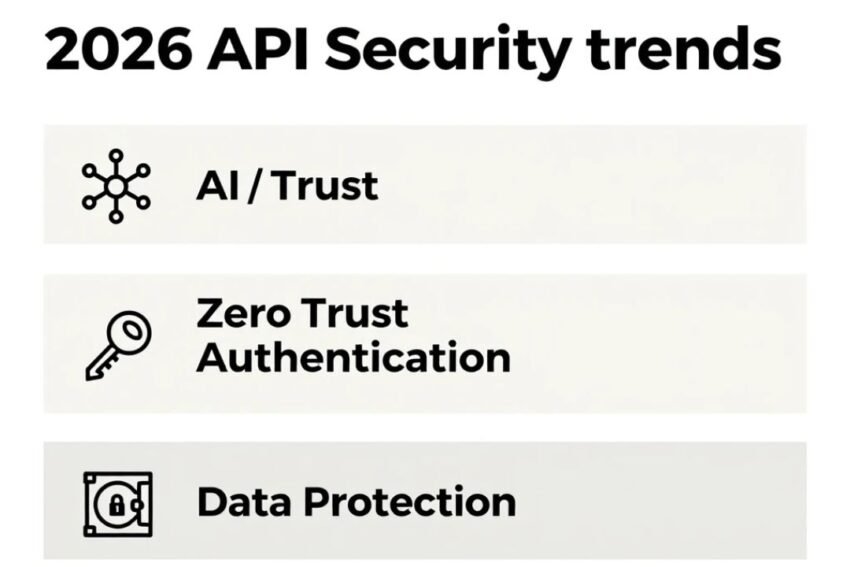
At the same time, organizations are adopting new technologies to strengthen API protection. Artificial intelligence, Zero Trust security, stronger authentication, automated API discovery, behavioral monitoring, encryption, and DevSecOps are becoming important components of modern API security strategies.
This guide explores the top API security trends in 2026, including AI-powered protection, Zero Trust, authentication, data security, API discovery, automated testing, cloud security, and the future of secure API development.
Why API Security Matters in 2026
APIs provide direct communication between software systems and often expose valuable functions or data.
Modern APIs may provide access to:
- Customer information
- Financial transactions
- Account details
- Business databases
- Cloud resources
- User profiles
- Internal applications
- Payment systems
A security weakness in an API can therefore affect more than a single application.
Organizations need to protect APIs throughout their entire lifecycle, including design, development, testing, deployment, monitoring, and retirement.
1. AI-Powered API Security
Artificial intelligence is becoming an important API security technology.
Traditional security systems often depend on predefined rules and signatures. AI-based systems can analyze API behavior and identify unusual patterns.
AI security systems may analyze:
- Request frequency
- User behavior
- API endpoints
- Authentication activity
- Data access patterns
- Geographic activity
- Traffic changes
For example, if an account suddenly sends thousands of API requests or accesses unusual resources, an AI-powered security system may identify the behavior as suspicious.
AI can help security teams prioritize potential threats, but organizations should still maintain human oversight and established security controls.
2. Zero Trust API Security
Zero Trust is becoming increasingly relevant to API protection.
Traditional network security sometimes assumes that internal traffic is trustworthy. Zero Trust uses a different approach by requiring access to be verified continuously.
For API environments, Zero Trust can involve:
- Strong identity verification
- Least-privilege access
- Continuous authentication
- Resource-level authorization
- Device and context evaluation
- Continuous monitoring
Instead of automatically trusting an API request because it comes from an internal network, organizations can evaluate whether that specific request should be allowed.
3. Stronger API Authentication
Authentication remains one of the most important parts of API security.
In 2026, organizations are increasingly focused on stronger authentication methods and better credential management.
Common technologies include:
- OAuth
- OpenID Connect
- API keys
- JSON Web Tokens
- Mutual TLS
- Multi-factor authentication
The appropriate method depends on the application and use case.
Organizations should also implement secure token expiration, credential rotation, and protection against credential theft.
4. Advanced Authorization
Authentication identifies a user or application, but authorization determines what that identity is allowed to access.
Weak authorization can allow legitimate users to access resources that belong to other users.
Modern API security therefore focuses heavily on detailed authorization policies.
These can include:
- Role-based access control
- Attribute-based access control
- Scope-based permissions
- Resource-level authorization
- Least-privilege policies
Authorization should be checked on sensitive API operations rather than assuming that authentication automatically grants access.
5. Automated API Discovery
Many organizations do not have complete visibility into their API environments.
Development teams may create new APIs, temporary endpoints, internal services, or third-party integrations.
This can create security gaps.
Automated API discovery tools can help organizations identify:
- Public APIs
- Internal APIs
- Shadow APIs
- Deprecated APIs
- Unused endpoints
- Third-party APIs
A complete API inventory allows security teams to understand what needs protection.
6. API Security Testing
Security testing is becoming increasingly integrated into software development.
Organizations can test APIs for weaknesses before deployment.
Common approaches include:
- Vulnerability scanning
- Penetration testing
- Fuzz testing
- Automated security testing
- Authentication testing
- Authorization testing
Automated testing can run during development and CI/CD pipelines, helping developers identify problems earlier.
7. API Security and DevSecOps
DevSecOps integrates security into software development and deployment.
Instead of testing security only after an API is completed, developers can include security controls throughout the development lifecycle.
A modern API development workflow may look like:
Design → Development → Security Testing → Code Review → Deployment → Monitoring
This approach can help organizations detect vulnerabilities before APIs become production systems.
8. API Gateway Security
API gateways can provide a centralized security layer between clients and backend services.
They can support:
- Authentication
- Authorization
- Rate limiting
- Request filtering
- Traffic management
- Logging
- API routing
API gateways can simplify security management, especially when organizations operate many microservices.
However, organizations should not depend exclusively on the gateway. Security controls should also exist within applications and backend services.
9. Rate Limiting and API Abuse Prevention
API abuse remains an important security challenge.
Attackers can send large numbers of requests to:
- Overload services
- Guess credentials
- Scrape information
- Search for vulnerabilities
- Consume resources
Rate limiting controls how many requests a user, application, IP address, or API key can make within a specific period.
More advanced systems can also use behavioral analysis to distinguish normal traffic from suspicious activity.
10. Better Data Protection
APIs frequently transfer sensitive information.
Organizations should ensure that APIs expose only the data required for each operation.
Security teams should pay attention to:
- Personal information
- Financial information
- Authentication credentials
- Internal business data
- Access tokens
- Customer records
Data minimization can reduce the impact of a compromised API.
Sensitive information should also be protected using encryption and appropriate access controls.
11. API Encryption
Encryption protects information while it travels between systems.
TLS-based HTTPS connections are a fundamental security requirement for modern APIs.
Organizations may also use additional encryption mechanisms for sensitive information stored within databases or other systems.
Encryption can reduce the risk of data interception and unauthorized access.
12. API Runtime Protection
API security does not end when an application is deployed.
Runtime protection allows organizations to monitor APIs while they are operating.
Security teams can look for:
- Unusual request patterns
- Unexpected access
- Authentication failures
- High-volume requests
- Suspicious data transfers
- Unusual endpoint activity
Runtime monitoring can provide valuable information for incident detection and response.
13. Behavioral Analytics
Behavioral analytics focuses on how users and applications normally interact with APIs.
For example, a customer application may normally make a predictable number of requests each day.
If the same identity suddenly accesses hundreds of unusual resources, behavioral analytics can identify the deviation.
This approach can complement traditional rule-based security systems.
14. Cloud API Security
Cloud services depend heavily on APIs.
Organizations use cloud APIs to manage:
- Virtual machines
- Databases
- Storage
- Networks
- Identity systems
- Containers
- Applications
A compromised cloud API can therefore create significant security risks.
Cloud API security should include strong identity management, least-privilege permissions, encryption, logging, monitoring, and secure configuration.
15. API Security for Microservices
Microservices architectures can create large numbers of API connections.
A modern application may contain dozens or hundreds of individual services.
Each service may communicate with other services through APIs.
This increases the importance of:
- Service authentication
- Service authorization
- Encryption
- Network segmentation
- Monitoring
- API inventory management
Organizations should avoid assuming that internal microservice traffic is automatically safe.
16. API Security for Mobile Applications
Mobile applications frequently communicate with backend services through APIs.
Attackers may attempt to reverse-engineer mobile applications to discover API endpoints or authentication mechanisms.
Organizations can improve mobile API security through:
- Strong authentication
- Secure token management
- TLS encryption
- Authorization controls
- Rate limiting
- Runtime monitoring
Mobile APIs should also avoid exposing sensitive information unnecessarily.
17. API Security and IoT
The Internet of Things is creating another large API security challenge.
Smart devices can communicate with cloud platforms and other systems using APIs.
Examples include:
- Smart cameras
- Industrial sensors
- Connected vehicles
- Smart appliances
- Wearable devices
Many IoT environments contain large numbers of connected devices, making identity management and access control especially important.
18. API Security Automation
Security automation can help organizations manage large API environments.
Automated systems can assist with:
- API discovery
- Vulnerability detection
- Configuration checking
- Policy enforcement
- Threat detection
- Incident alerts
Automation can reduce the amount of manual work required by security teams.
However, automated responses should be carefully designed because incorrectly blocking legitimate API traffic can affect business operations.
19. API Security Posture Management
As API environments become more complex, organizations need better visibility into their security posture.
API security posture management can involve identifying:
- Vulnerable APIs
- Misconfigured endpoints
- Weak authentication
- Excessive permissions
- Outdated APIs
- Exposed sensitive data
Organizations can then prioritize the highest-risk issues.
20. Post-Quantum Cryptography
Quantum computing could eventually affect some existing cryptographic systems.
Although practical large-scale quantum attacks against widely used cryptographic systems are not a routine API security threat today, organizations are beginning to consider post-quantum cryptography as part of long-term security planning.
Future API infrastructures may gradually adopt cryptographic algorithms designed to resist potential quantum attacks.
API Security Best Practices for 2026
Organizations can strengthen their API security strategy by following practical measures.
1. Maintain an API Inventory
Know which APIs exist and who owns them.
2. Use Strong Authentication
Protect APIs with appropriate modern authentication mechanisms.
3. Enforce Authorization
Check permissions for every sensitive operation.
4. Apply Least Privilege
Give identities only the access they require.
5. Encrypt API Traffic
Use secure TLS connections.
6. Validate Inputs
Reject malformed and unexpected requests.
7. Use Rate Limits
Control excessive traffic and potential abuse.
8. Monitor API Activity
Look for unusual behavior and suspicious access.
9. Test APIs Regularly
Include automated testing and periodic security assessments.
10. Remove Deprecated APIs
Old and unused endpoints can create unnecessary security exposure.
How AI and Zero Trust Work Together
AI and Zero Trust can complement each other.
Zero Trust provides the security principle that every request should be evaluated rather than automatically trusted.
AI can analyze large amounts of activity and help identify unusual behavior.
For example:
Identity verification → Permission check → Behavioral analysis → Risk evaluation → Access decision → Continuous monitoring
This combination can create a more adaptive API security strategy.
API Security Challenges in 2026
Despite technological improvements, organizations still face several challenges.
API Sprawl
Organizations may operate thousands of APIs across different environments.
Shadow APIs
Unknown APIs can remain outside normal security controls.
Complex Permissions
Modern applications can have complicated authorization requirements.
Third-Party Integrations
External APIs introduce additional dependencies and risks.
Rapid Development
Frequent application updates can create new security weaknesses.
Human Error
Incorrect configuration and poor credential management can undermine strong technologies.
The Future of API Security
API security is likely to become increasingly intelligent and automated.
Future systems may combine:
- AI threat detection
- Continuous authentication
- Zero Trust architecture
- Automated API discovery
- Advanced behavioral analytics
- Automated security testing
- Stronger encryption
- Post-quantum cryptography
- Cloud-native security
Organizations may also increasingly treat APIs as critical digital assets rather than simply software interfaces.
Conclusion
API security trends in 2026 reflect the growing importance of protecting the interfaces that connect modern digital systems.
AI-powered security, Zero Trust, stronger authentication, advanced authorization, automated API discovery, behavioral analytics, API gateways, DevSecOps, and cloud security are all becoming important parts of modern API protection.
At the same time, organizations must address persistent challenges such as API sprawl, shadow APIs, excessive permissions, insecure configurations, third-party integrations, and outdated endpoints.
The strongest API security strategy is not based on one tool. It combines identity, authorization, encryption, monitoring, testing, automation, and human oversight.
As businesses continue adopting cloud computing, microservices, mobile applications, IoT, and AI-powered software, API security will remain a critical part of modern cybersecurity.
Organizations that build security into the complete API lifecycle can reduce risk while creating more reliable and resilient digital services.